
Catheterisation Trainers for Urinary Catheterisation Skills Training
Your guide to the Limbs & Things Catheterisation trainers

Develop safe, repeatable, and clinically relevant urinary catheterisation skills using realistic simulation trainers designed for healthcare education, skills labs, and clinical competency assessment.
What is Catheterisation Training?
Urinary catheterisation is a fundamental clinical procedure performed across a wide range of healthcare settings. Healthcare professionals must be able to safely insert, manage, and remove urinary catheters while maintaining patient dignity, comfort, and infection prevention standards.
Simulation-based catheterisation training allows learners to practise essential skills in a controlled environment before performing procedures on real patients. This helps build confidence, improve procedural accuracy, and reduce the risk of catheter associated complications.
The Limbs & Things Catheterisation range supports training in:
- Male urethral catheterisation
- Female urethral catheterisation
- Suprapubic catheterisation
- Aseptic technique
- Catheter care and maintenance
- Troubleshooting catheterisation challenges
- Communication and patient centred care
Three Training Solutions. One Complete Learning Pathway.
Male Catheterisation Trainer
Designed to teach male urinary catheterisation techniques, this trainer provides realistic anatomy and procedural feedback to support skill development from beginner through to advanced levels.
Key features include:
- Anatomical accuracy, including true-to-life mobility of the penis to replicate real world catheter insertion
- Retractable and removable foreskin, allowing learners to practise appropriate foreskin management and understand the prevention of paraphimosis
- Supple urethral meatus and realistic internal sphincter resistance to provide authentic catheter insertion feedback
- Realistic urethral pathway that closely replicates clinical catheterisation procedures including feel of the urinary sphincter
- Ability for beginners to view catheter pathway
- Urine flow confirmation of successful catheter placement
- Simple cleaning and maintenance for high-volume training environments
- Latex-free material to minimise allergic reactions
Male Catheterisation Trainers, modules, and consumables.


Female Catheterisation Trainer
The Female Catheterisation Trainer supports the development of confidence and competence in female catheterisation procedures.
Key features include:
- Female anatomically accuracy female anatomy with soft labia that support aseptic no-touch technique (ANTT) training
- Enhanced realism that helps learners identify anatomical landmarks correctly and avoid incorrect catheter placement
- Realistic catheter insertion pathway with authentic tactile feedback via the resistive sphincter
- Urine flow feedback upon successful catheter placement
- Ability to practice suprapubic catheter management
- Latex free material
- Durable design suitable for repeated catheterisation practice
- Simple cleaning and maintenance between training session
Female Catheterisation Trainers, modules, and consumables.


Suprapubic Ultrasound Catheterisation Module
The Suprapubic Ultrasound Catheterisation Module enables advanced urinary catheterisation training and image-guided procedural practice.
Key features include:
- Ultrasound compatible anatomy for realistic scanning and image acquisition
- Ultrasound bladder scanning capabilities that allow learners to assess bladder volume, and recognise potential urinary retention
- Visualisation of catheter position and pathway during procedures
- Ultrasound guided suprapubic catheter insertion training
- Supports advanced urology and specialist procedural education
- Realistic tissue response and procedural feedback
Together, these trainers provide a comprehensive pathway from routine urinary catheterisation to more advanced suprapubic access procedures.
Why Does Catheterisation Training Matter?
Urinary catheterisation is one of the most commonly performed invasive procedures in healthcare. Despite its frequency, complications can occur if the procedure is performed incorrectly.
Common risks include:
- Catheter associated urinary tract infections (CAUTIs)
- Urethral trauma
- Patient discomfort and distress
- Incorrect catheter placement
Clinical guidelines emphasise the importance of appropriate training, competency assessment, and adherence to aseptic technique when performing catheterisation procedures. Simulation allows learners to gain experience and confidence before treating patients.
Simulation training also allows learners to practise important safety considerations such as aseptic no-touch technique (ANTT), correct foreskin management, anatomical identification, and prevention of catheter-associated urinary tract infections (CAUTIs), helping reduce the risk of avoidable patient harm.
Why Ultrasound Matters in Catheterisation Training
Ultrasound Guided Catheterisation Training
Point-of-care ultrasound is increasingly used to assess bladder volume, identify urinary retention, and support decision making before catheter insertion.
Using ultrasound within simulation training allows learners to:
- Assess bladder filling and urine volume
- Reduce unnecessary catheter insertion
- Visualise catheter placement and anatomical structures
- Develop image guided procedural skills in a safe environment
The Suprapubic Ultrasound Catheterisation Module allows educators to teach both diagnostic assessment and procedural intervention using a single training platform.
Who Uses Catheterisation Simulators?
The Catheterisation range is suitable for:
- Undergraduate nursing education
- Undergraduate medical education
- Foundation and residency programmes
- Urology training
- Emergency medicine training
- Community nursing programmes
- Skills laboratories and simulation centres
- OSCE and competency assessments
- Continuing professional development (CPD)
The trainers support both formative learning and summative assessment, making them valuable tools throughout a learner's clinical journey.
Designed Around Educator Feedback
Designed for Efficient Skills Training
The Catheterisation range has been developed to support both learners and educators in busy teaching environments.
Benefits include:
- Modular design allowing male, female, and suprapubic catheterisation training units to be used individually or as part of a comprehensive training programme
- Easy cleaning and maintenance between training sessions
- Integrated augmented reality to help visualise the internal anatomy and catheter pathway
- Reusable double sleeve catheter packaging that replicates the packaging used with many clinical urinary catheters while reducing consumable costs
- Water-based lubricant supplied to simulate clinical practice more accurately
Key Features of the Catheterisation Range
Designed for Realistic, Repeatable Training
The trainers replicate key anatomical structures and procedural steps encountered during real catheterisation procedures.
Learners can practise:
- Patient preparation
- Equipment selection
- Aseptic technique
- Catheter insertion
- Balloon inflation procedures
- Catheter management
- Catheter removal
This enables repeated deliberate practice without patient risk.
Procedural Feedback That Reinforces Learning
Successful catheter placement is confirmed through realistic procedural outcomes, helping learners understand the relationship between technique and clinical success.
Training benefits include:
- Immediate procedural feedback
- Reinforcement of correct technique
- Identification of common errors
- Improved confidence before patient contact
Built for High Volume Skills Training
The Catheterisation range is designed for frequent use in healthcare education environments.
Benefits include:
- Replaceable consumable components
- Suitable for repeated catheter insertions
- Cost-effective long term training solution
Ideal for:
- Nursing schools
- Universities
- Medical schools
- Simulation centres
- Hospital education departments
| Training Scenario | Skills Developed | Benefits |
|---|---|---|
| Basic Urinary Catheterisation |
|
|
| Difficult Catheterisation Cases |
|
|
| CAUTI Prevention Training |
|
|
| Community Nursing Skills |
|
|
| Urology Education |
|
|
| OSCE & Competency Assessment |
|
|
| Ultrasound Guided Suprapubic Catheterisation |
|
|
What's Included?
What can you expect to find when you unpack your Catheterisation Trainer delivery?
| Product Components |
Female Cath Trainer
60851 (Light) 60869 (Dark) |
Male Cath Trainer
60850 (Light) 60870 (Dark) |
Standard Cath Set
60853 (Light) 60871 (Dark) |
Advanced Cath Set
60854 (Light) 60872 (Dark) |
|---|---|---|---|---|
| Female Catheterisation Module | Yes | No | Yes | Yes |
| Male Catheterisation Module | No | Yes | Yes | Yes |
| Pelvic Shell & Stand | Yes | Yes | Yes | Yes(x2) |
| Augmented Reality Mat | Yes | Yes | Yes | Yes(x2) |
| Water System | Yes | Yes | Yes | Yes(x2) |
| Foreskins (Pack of 3) | No | Yes | Yes | Yes |
| Aseptic Catheterisation Sleeves (Pack of 2) | Yes | Yes | Yes | Yes(x2) |
| Lubricant Gel | Yes | Yes | Yes | Yes(x2) |
| Antifungal Agent | Yes | Yes | Yes | Yes(x2) |
| Plastic Kidney Dish | Yes | Yes | Yes | Yes(x2) |
| Water Tubing Extension | Yes | Yes | Yes | Yes(x2) |
| 14 Fr Foley Catheter | Yes | Yes | Yes | Yes(x2) |
Your delivery will look similar to this:
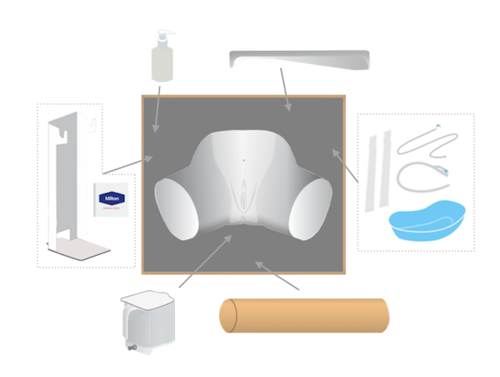
The trainer torso, module and perineum (male or female, depending on model ordered) will sit in the centre of the packaging. If a male trainer has been ordered, the additional foreskin pack will be supplied with the additional loose items.
Technical Specifications
| Technical Specification | Catheterisation Trainers & Sets |
|---|---|
| Dimensions & Weight (Packed) |
Male/Female Trainers: L 66cm x W 31cm x H 51cm. 10kg Suprapubic Unit: L 38cm x W 25cm x H 27cm. 4kg Standard Set: L 66cm x W 31cm x H 51cm. 11.2kg Advanced Set:
|
| Materials (Trainers) |
|
| Recommended equipment |
|
| Consumable components |
|
Setting up the Catheterisation Trainer
When you initially receive your catheterisation trainer you will need to install the bladder in the correct position. This is different for male and female scenarios. Watch this short video on setting up your trainer. You can also download the User Guide for clear illustrated guidance.
0:00 Setting up the bladder unit
0:31 Setting up the catheterisation module
1:19 Filling bladder with water
1:53 Preparing for catheterisation
How to Perform Urinary Catheterisation (Simulation Overview)
The trainers support structured, step-by-step teaching of urinary catheterisation procedures.
A typical training sequence includes:
- Confirm patient identity and explain the procedure
- Prepare equipment and establish a sterile field
- Position the patient appropriately
- Identify anatomical landmarks
- Clean the insertion site using aseptic technique
- Lubricate and insert the catheter
- Confirm successful placement
- Inflate the retention balloon where appropriate
- Secure the catheter and connect drainage equipment
- Document the procedure
Learners can repeat the process multiple times to refine technique, improve efficiency, and develop confidence.
How to Dismantle & Store the Catheterisation Trainer
Following training sessions, it is important to dismantle and dry the components before storing.
- Disconnect the tubing from the water system and drain excess water
- Dispose of water from the water jug
- Remove perineum, and internal fittings, from the module case
- Remove bladder and empty
- Unscrew and remove the bladder Diaphragm and valve from the connector
- Dry all components thoroughly
When reassembling the bladder component, remember to add a small amount of lubricant to the diaphragm before replacing the white bottle top.
For the safest storage, reassemble the unit and trainer, and place inside the carry case.
Why Use a Simulation Trainer?
Traditional clinical training presents challenges:
- Limited patient opportunities
- Patient discomfort
- Variable anatomy and presentations
- Risk of procedural complications
- Limited opportunities for repeated practice
Simulation trainers provide:
- Safe learning environments
- Standardised educational experiences
- Repeatable skills practice
- Immediate feedback
- Objective assessment opportunities
This helps learners develop competence before performing procedures in clinical practice.
Consumables & Replacement Parts
The Catheterisation range is designed for ongoing, hassle-free training.
Should any part of your trainer require replacement but is not listed, please contact our Customer Service team.


Frequently Asked Questions
What is urinary catheterisation?
Urinary catheterisation is the insertion of a catheter through the urethra and into the bladder to drain urine, monitor output.
Why should catheterisation be practised using simulation?
Simulation enables healthcare professionals to develop technical skills, confidence, and procedural competence before performing catheterisation on patients.
Is the trainer suitable for beginners?
Yes. The trainers support learners ranging from novice healthcare students through to experienced clinicians undertaking competency assessments or advanced procedural training.
Can the trainers be used for assessment?
Yes. The models are suitable for OSCEs, competency assessments, skills validation, and continuing professional development activities.
What specialties use catheterisation training?
Catheterisation training is commonly used within nursing, medicine, urology, emergency medicine, surgery, intensive care and community healthcare education.
Can learners practise bladder scanning?
Yes. The Suprapubic Ultrasound Catheterisation Module supports ultrasound bladder scanning, allowing learners to assess bladder volume and practise clinical decision-making before catheter insertion.
Can the catheter path be visualised during training?
Yes. The ultrasound compatible design of the Suprapubic Units enables educators and learners to visualise catheter position and pathway, supporting real-time feedback and improved understanding of internal anatomy.
Why is foreskin management included in catheterisation training?
Correct foreskin management is an important aspect of male catheterisation. The retractable foreskin allows learners to practise appropriate techniques and understand how incorrect management can contribute to complications such as paraphimosis.
Thanks for reading!
Found this article useful? Why not share it with a colleague, or contact us about another product you'd like to hear more about.
