
Arterial Puncture Wrist Trainers for ABG Sampling & Cannulation Training
Deliver safe, repeatable, and clinically relevant training in arterial puncture and cannulation using high-fidelity wrist models designed for modern simulation environments.

What is an Arterial Puncture Wrist trainer?
The Arterial Puncture Wrists support both palpation-based learning and ultrasound-guided vascular access, enabling learners to progress from foundational skills to advanced procedural competence within a single training ecosystem.
Two Training Solutions. One Complete Learning Pathway.
Arterial Puncture Wrist - Standard
Designed for early to intermediate learners, the standard model focuses on developing tactile skills essential for arterial access.
- Palpable radial artery with realistic pulsation
- Adjustable heart rate and blood pressure simulation
- Immediate feedback via simulated flashback
- Ideal for ABG sampling and basic cannulation training
Arterial Puncture Wrist - Ultrasound
Built for more advanced training, the ultrasound-compatible model introduces image-guided procedural skills.
- All features of the standard model
- Ultrasound-compatible tissue for vessel visualisation
- Supports dynamic needle guidance techniques
- Enables transition to real-world ultrasound practice
Why does Arterial Puncture Training Matter?
Arterial puncture is a core clinical skill used in arterial blood gas (ABG) analysis, haemodynamic monitoring, and critical care management. The radial artery is the most commonly accessed site due to its accessibility and collateral circulation.
Simulation-based training allows clinicians to develop accuracy, confidence, and procedural consistency before performing on patients-supporting safer outcomes and improved competency.
Who uses an arterial puncture wrist simulator?
The Arterial Puncture Wrist is suitable for:
- Undergraduate medical education
- Foundation and residency training
- Anaesthesia and ICU programmes
- Emergency medicine training
- OSCE and competency assessments
- Continuing professional development (CPD)
It supports both formative learning and summative assessment, making it a versatile addition to any simulation curriculum.
Key Features of the Arterial Puncture Wrists
Designed for Realistic, Repeatable Training
Anatomical and Physiological Realism
The trainer replicates key characteristics of the radial artery:
- Palpable pulse with adjustable rate (e.g. bradycardic to tachycardic ranges)
- Variable blood pressure settings to simulate different clinical states
- Realistic vessel depth and resistance
This allows learners to experience the subtle differences in arterial access under varying conditions.
Procedural Feedback That Reinforces Learning
Successful needle placement is confirmed through:
- Simulated arterial “flashback”
- Continuous blood flow feedback
- Realistic resistance during insertion
These features help learners link technique to outcome, accelerating skill acquisition.
Built for High-Volume Training
- Replaceable skin and vessel components
- High durability for repeated cannulation
- Cost-effective consumable system
Ideal for simulation centres, teaching hospitals, and skills labs delivering frequent training sessions.
Simple Maintenance and Turnaround
- Integrated cleaning system
- Quick drainage and refill
- Minimal downtime between sessions
Supports efficient use in busy training environments.
Ultrasound-Guided Arterial Access Training
The increasing use of ultrasound in vascular access has made image-guided cannulation a critical competency, particularly in emergency medicine, anaesthesia, and intensive care.
The ultrasound model enables learners to:
- Visualise the radial artery in real time
- Practise probe positioning and optimisation
- Develop needle tracking techniques
- Build confidence before clinical application
This creates a progressive learning pathway, from palpation-based techniques to advanced ultrasound-guided procedures.
| Scenario | Training Focus | Benefits of APW |
|---|---|---|
| Acute Deterioration & ABG Interpretation - A patient presents with shortness of breath, hypoxia, or altered consciousness |
|
|
| Emergency Department / Resus Bay Training - Critically unwell patient requiring urgent assessment (e.g. sepsis, trauma, respiratory failure) |
|
|
| Difficult Arterial Access - Patient with weak pulse, hypotension, obesity, or vascular disease |
|
|
| ICU / Anaesthesia Arterial Line Placement - Insertion of arterial lines for continuous blood pressure monitoring |
|
|
| Infection Control & Aseptic Technique Training - Teaching correct procedural hygiene in invasive techniques |
|
|
| Ultrasound-Guided Arterial Cannulation - Learners transitioning from landmark techniques to ultrasound-guided practice |
|
|
| OSCE & Competency Assessment Stations - Structured clinical examinations or workplace-based assessments |
|
|
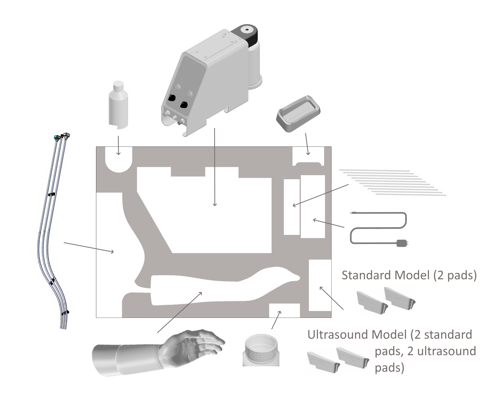
What's included with the APW?
| Product Components | Arterial Puncture Wrist 72500 | Arterial Puncture Wrist - Ultrasound 72501 |
|---|---|---|
|
Arterial Puncture Wrist Unit (ready to use)
|
Yes | Yes |
| Standard Block (x2) | Yes | Yes |
| Ultrasound Block (x2) | No | Yes |
| APW Vessels (x10) | Yes | Yes |
| APW Stand | Yes | Yes |
| APW Fluid Bottle | Yes | Yes |
| APW Pump Unit | Yes | Yes |
| Power Cord | Yes | Yes |
| Blood Concentrate | Yes | Yes |
Your delivery will look similar to this:
Technical Specifications |
Arterial Puncture Wrist Trainer |
|---|---|
| Dimensions | L 65cm x W 45cm x H 16cm |
| Weight (packed) | Standard Model: 5.1kg Ultrasound Model: 5.3kg |
| Materials - Wrist | Silicone |
| Materials - Arteries | Latex free |
| Recommended equipment* (not supplied) |
|
| Electrical supply |
|
| Conformity | EU Declaration of Conformity/UKCA Declaration of Conformity
|
| Consumable components | Standard Model
Ultrasound Model
|
| *Any size needle can be used with the Arterial Puncture Wrist trainers, however, wider gauge needles can reduce the lifespan of the veins and skin cuff and may void warranty. | |
Setting up the APW Trainer and pump
Find out everything you need to set up your Arterial Puncture Wrist. Watch a member of our team setting up the model in this video clip, or jump to a specific section using the timings below.
0:13 Attaching the vessels
0:48 Putting the hand skin on
1:44 Inserting the Standard Block
2:06 Placing the Skin Cuff
2:40 Inserting the Ultrasound Block
3:23 Setting up the pump
3:30 Filling and installing the fluid bottle
3:44 Turning on the power
3:50 Connecting the tubing and priming the system
You can also download the User Guide for a full, illustrated, step-by-step guide, or watch the complete Hints & Things video for APW on our YouTube channel.
How to Perform Arterial Puncture (Simulation Overview)
This trainer supports structured, step-by-step teaching of arterial puncture:
- Position the wrist to expose the radial artery
- Palpate and identify the point of maximal pulsation
- Prepare the site using aseptic technique
- Insert the needle at the appropriate angle
- Observe arterial flashback indicating correct placement
- Advance the cannula or collect the blood sample
If using the Ultrasound Arterial Wrist Inserts: follow steps 1 to 3, above, then use the ultrasound wand to locate the artery and guide the needle to enter the artery. Continue with steps 5 and 6.
Learners can repeat this process multiple times, refining technique with each attempt.
Why Use a Simulation Trainer?
Traditional training methods present limitations:
- Real patients: limited opportunities, safety concerns
- Low-fidelity models: lack of realism and feedback
- Cadavers: limited availability and variability
A dedicated arterial puncture trainer provides:
- Safe, controlled learning environment
- Standardised training experience
- Opportunity for repetition and mastery
- Immediate, objective feedback
Cleaning & Maintenance
Simple, one click cleaning system - With one press of the “clean” button on the APW Pump, the blood system will drain back into the fluid bottle.
To ensure consistent ongoing performance we advise rinsing the system regularly, using the same cleaning program and a solution of water and sterilisation agent. This helps to prevent blockages from dried blood pools in the tubing and at connection points.
Monitor the components of your APW trainer. Skin Cuffs, vessels and block inserts that show blood seepage on their surfaces can be an indication that it is reaching end of life, or potentially has damage. Blood pooling in the wrist cavities could also indicate that a vessel connection is loose. Ensuring tight connections within the system will ensure accurate and consistent pressure during practises.
Consumables & Replacement Parts
The Arterial Puncture Wrist is ideal for ongoing, hassle free, training. All consumable components below are designed for repeated use and easy replacement when needed.
The following items are Consumables for the Arterial Wrist trainers:
- Vessels Pack of 10
- Standard Arterial Puncture Blocks
- Ultrasound Arterial Puncture Blocks
- Skin Cuff
- Concentrated Blood, available in:
Replacement Parts:
Should any part of your trainer need replacing but isn’t mentioned on this page or available through the website, contact our Customer Service team.
Top Tip: If you use your APW trainer multiple times a week, an additional fluid bottle for water/sterilising agents can be used to reduce time during set up and storage of your model, as it allows you to keep diluted blood in the original bottle for easy fitting.
Note: Diluted blood should be stored in an airtight container in a cool, dark, place. The latest formula used for the Limbs & Things concentrated blood gives it a longer shelf life and makes it safe for disposal in general drainage systems.
Why choose the Limbs & Things Arterial Puncture trainer?
Improved patient safety
Simulation allows learners to practise arterial puncture without risk to patients, reducing complications such as haematoma, arterial injury, or infection during early skill acquisition.
Opportunity for repetition and skill mastery in a safe environment
Unlike clinical settings where opportunities may be limited, simulation enables deliberate, repeated practice, helping learners refine technique and improve first-pass success rates.
Learners can make mistakes, adjust technique, and build confidence in a low-pressure environment, which is critical for developing competence before performing on patients.
Standardised training experience with immediate feedback and skill reinforcement
All learners can be exposed to the same anatomy, difficulty level, and procedural conditions, ensuring consistency in teaching and assessment across cohorts.
Simulation models provide real-time procedural feedback (e.g. flashback, resistance), allowing learners to directly connect their technique with outcomes and accelerate learning.
Repeated exposure and successful practice in simulation environments help build confidence and procedural readiness, leading to better performance in real clinical settings.
Exposure to variable clinical scenarios integrated with critical decision making
Adjustable simulation parameters (e.g. pulse strength, blood pressure) allow training in both routine and challenging cases, including hypotension or difficult arterial access.
Simulation can be embedded into scenarios (e.g. respiratory failure, sepsis), enabling learners to combine procedural skills with clinical reasoning, not just technical execution.
Supports ultrasound skill development
For advanced learners, simulation provides a platform to practise ultrasound-guided arterial access, including probe handling and needle visualisation, before clinical application.
Facilitates objective assessment
Simulation enables structured evaluation using checklists and competency frameworks, supporting OSCEs, workplace-based assessments, and progression tracking.
Cost-effective long-term training solution
While requiring initial investment, simulation reduces reliance on opportunistic clinical exposure and allows high-volume, reusable training, improving overall training efficiency.
Easy maintenance & cleaning
Intuitive component design and the innovative one button self-cleaning mode, reduce prep and turnaround time.
Frequently Asked Questions
What is arterial puncture used for?
Arterial puncture is primarily used to obtain arterial blood samples for blood gas analysis, which provides critical information about oxygenation, ventilation, and acid–base status.
Is the puncture wrist suitable for beginners?
Yes. The standard model is specifically designed for early-stage learners, while the ultrasound version supports progression to advanced skills.
Can I use this with any ultrasound machine?
The ultrasound model is compatible with standard clinical ultrasound systems, allowing realistic imaging and training.
How often do components need replacing?
This depends on usage volume, but replaceable parts are designed for high repetition and cost efficiency, supporting frequent training sessions.
What pulse rates and blood pressures can be simulated with the APW trainer?
The pump system has two individual controls that allow for multiple scenarios to be set.
Pulse rate can be set to 40, 80, 120bpm, and blood pressure to Low (90/60), Medium (120/80) or High (150/110).
How many punctures can the Arterial Wrist inserts withstand?
Usage of the Arterial Puncture blocks depends on which type you use, and how they are set up.
Under ideal conditions the Standard Block with the Skin Cuff on, can facilitate around 150 sticks/needle insertions and 75 cannulations. The Ultrasound Block with the Skin Cuff on can do around 75 sticks and 50 cannulations.
Note: Usage will depend on the skill used and whether the Skin Cuff is fitted to the model.
How many punctures can the Arterial puncture wrist skin withstand?
The Skin Cuff has the longest life of the APW consumables. Rotating the cuff and repositioning it over the inserts can prolong its life to around 400 sticks and 200 cannulations.
Can this be used for assessment?
Yes. The trainer is suitable for structured assessments, including OSCE stations and competency evaluations.
How do you clean the APW model?
The pump unit has an easy clean mode, with one press of the button it will drain the system of fluid, back into the attached bottle. You can then use the same function to prime and flush the system with water (and antifungal agent) to prevent blockages and potential mold build up inside.
The components of the wrist itself can be cleaned with a damp cloth, using warm water and mild detergent.
Note: While the inserts, vessels, skin cuff and wrist skin can be briefly submerged in warm water to clean them, we would advise against doing this with the whole wrist. Do not submerge the pump in water, ensure that the power is off and the unit is unplugged before wiping the outside of the unit with a damp cloth.
Ensure all components are dry before reassembling and storing.
How often does the synthetic blood need to be replaced?
We recommend changing the diluted liquid at least once every 12 months. The formula includes an EU approved preservative that extends the life of the solution, making it safer to use over extended periods, as well as being safer on skin contact and less hazardous when disposed of.
For best shelf life, ensure the jug is sealed tightly and stored in a cool, dark place between uses. Monitor the liquid for signs of crystallisation or separation, if you observe any changes, we would recommend replacing the solution.
What equipment can be used?
We recommend the following equipment be used with the Arterial Puncture Wrist:
- 25-23Ga Radial Artery Sampling Kit (using with dry lithium heparin syringes)
- 22G needle with a 20G cannula Seldinger catheterisation set
- The echolucent material of the Ultrasound Inserts is compatible with all commonly used ultrasound probes
Note: Although other equipment can be used with the Wrist, we cannot guarantee the performance of the model, and larger gauge needles and cannulas will negatively affect the product’s lifespan and may void the warranty.
Ready to Improve Arterial Access Training?
Enhance your training programme with a solution that combines clinical realism, durability, and scalability.
Related Clinical Simulation Products


Arterial Wrist Related Documents
Thanks for reading!
Found this article useful? Why not share it with a colleague, or contact us about another product you'd like to hear more about.
