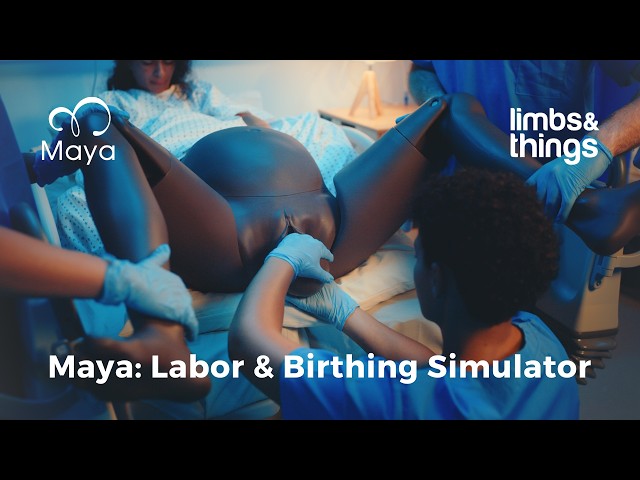
Maya - Labor & Birthing Simulator (Light Skin Tone)
Skin Tone
Automated birth. Focused teaching.
Maya is an automated birthing simulator designed to teach the key fundamentals of labor, birth and postpartum care. Combining the simplicity and portability of a task trainer with the realism and scenario-based learning of a full-body simulator, Maya enables educators to deliver high-quality obstetric training without the complexity of traditional simulation systems.
Controlled through an intuitive app, Maya allows educators and learners to set up and run realistic birthing scenarios in minutes. Automated births provide a consistent training experience from the first learner to the last, while rapid reset times maximise hands-on practice and skills acquisition.
Maya is an automated birthing simulator designed to teach the key fundamentals of labor, birth and postpartum care. Combining the simplicity and portability of a task trainer with the realism and scenario-based learning of a full-body simulator, Maya enables educators to deliver high-quality obstetric training without the complexity of traditional simulation systems.
Controlled through an intuitive app, Maya allows educators and learners to set up and run realistic birthing scenarios in minutes. Automated births provide a consistent training experience from the first learner to the last, while rapid reset times maximise hands-on practice and skills acquisition.
Whether used for undergraduate teaching, competency assessment, self-directed learning or multidisciplinary team training, Maya provides a flexible and accessible solution for obstetric simulation.
Automated Birth Simulation
Deliver realistic and repeatable birthing scenarios at the touch of a button. Automated fetal descent and delivery reduce facilitator workload while ensuring a consistent learning experience for every participant.
App-Controlled Scenario Management
Configure and control scenarios through a simple, user friendly app. Adjust labor progression, fetal position and birthing complications in seconds.
Vaginal Examination Training
Develop confidence in assessing:
- Cervical dilation
- Fetal station
- Presentation
- Position
The app allows educators to rapidly change examination findings, enabling learners to experience a wide range of clinical presentations.
Normal & Emergency Obstetric Scenarios
Train learners in the recognition and management of:
- Normal vaginal birth
- Vaginal breech birth
- Shoulder dystocia
- Assisted vaginal birth (forceps and vacuum)
- Third stage of labor complications
- Postpartum haemorrhage (PPH)
Quantitative Blood Loss Measurement
Integrated with the Clean Bleed® Mat, Maya enables realistic postpartum hemorrhage scenarios with up to 2.5 litres of simulated blood loss, supporting quantitative blood loss (QBL) training and assessment.
Designed for Independent Learning
Maya's intuitive setup and automated functionality allow learners to practise independently, reducing reliance on facilitators and increasing access to simulation-based education.
Skills and Procedures
Maya supports training and assessment in:
- Normal vaginal birth
- Vaginal breech birth
- Shoulder dystocia management
- Assisted vaginal birth
- Vaginal examination
- Labor progression assessment
- Third stage management
- Fundal massage
- Retained placenta management
- Quantitative blood loss measurement
- Postpartum hemorrhage management
- Urinary catheterization
- Intramuscular injection
- Communication skills
- Teamworking and escalation
Why Choose Maya?
Consistent Training Outcomes
Automated births provide reliable and repeatable scenarios that deliver the same high-quality experience throughout teaching sessions.
Increased Hands-On Practice
Rapid reset times allow more repetitions per learner, supporting deliberate practice and competency development.
Reduced Facilitator Burden
Educators can focus on teaching and feedback rather than manually controlling deliveries or managing complex simulator systems.
No Complicated Set-up
Simple setup and intuitive operation enable Maya to be used effectively by educators and learners straight out of the box.
Portable & Flexible
Maya can be used in skills laboratories, classrooms, simulation centres and clinical environments, making high-quality obstetric training more accessible than ever.
The Missing Link in Obstetric Simulation
Traditional task trainers often focus on isolated skills, while full-body simulators can be costly, complex and resource-intensive.
Maya bridges this gap by delivering realistic labour and birth simulation in a compact, accessible platform that supports both focused skills training and immersive obstetric scenarios.
From first exposure to labor management through to emergency obstetric training, Maya helps learners build competence, confidence and clinical readiness.

Overview
- Automated highly realistic birthing – Cephalic & Breech
- Various birthing positions with attachable lower legs
- Automated vaginal examination with four presenting parts and dilation of 4-10cm
- Programmable birthing scenarios for obstetric emergencies including shoulder dystocia & assisted vaginal birth
- Realistic baby boy with spinal flexion and correct palpable landmarks (Clavicles, scapula, Suture lines and fontanelles) & fully articulating arms & legs
- Magnetic placental piece for retained placenta
Realism
- Simulates various birthing scenarios, including, breach, shoulder dystocia, and assisted vaginal birth
- Built in Clean Bleed Mat replicates PPH blood loss for QBL calculation
Versatility
- 8 hour battery life, or can be powered directly from the mains
- Pre-set birthing scenarios using the app to run an automated birth
- Taking minutes to reset and minimal manual intervention between procedures, Maya is ideal for repeated use
Cleaning
- Wipe off excess lubricant from Maya and baby surfaces
- Clean the product with a soft damp cloth, warm water and mild detergent
- Allow the manikin and components to dry before storing
Safety
- This product is latex free
- Ensure baby and cervix are well lubricated. Unlubricated surfaces can stick together, damaging the trainer, reducing its lifespan, and may void your product warranty
- Wear gloves when handling the trainer and remove any sharp objects, sharp edges can lead to silicone damage
- Always lift the Maya trainer by the carrier handles
- Contains electronics. Do not submerge the Maya unit in water
Simulated Patient
- Designed for use with a simulated patient for patient-practitioner communication skills
Anatomy
- Female lower body, mid-chest to thighs, with detachable lower legs
- Baby with placenta and umbilical cord
Skills Gained
- Types of birth:
- Normal delivery
- Vaginal breech
- Shoulder dystocia
- Vaginal assisted, inc. forceps and vacuum devices
- Vaginal examination, inc. station, dilation, presentation & position of foetus
- Fundal massage
- Delivery of placenta
- Removal of retained placenta piece
- Quantitative measurement of blood loss (QBL)
- Urinary catheter placement
- IM injection
- Patient communication (when used in conjunction with a simulated patient)
- Teamwork
Evidence
Midwives' Experiences with Simulation-Based Education for Postpartum Haemorrhage Management (2026)
Ataş et al. (2026) Postpartum haemorrhage remains one of the leading causes of maternal morbidity and mortality worldwide. Effective recognition and intervention depend heavily on practical skills, decision-making, and team coordination. Key findings: • Simulation increased midwives' confidence in managing PPH • Participants reported improved clinical awareness and preparedness • Realistic scenarios helped learners recognise deterioration and practise escalation pathways • Teamworking and communication skills improved alongside technical competencies Application to Maya: Supports use of realistic maternal simulators for: • Recognition of excessive blood loss • Assessment following delivery • Emergency response workflows • Team-based obstetric emergency training
Simulation-Based Training Workshops for Obstetric Midwives (2024)
Wu et al., Frontiers in Medicine (2024) This study examined simulation training designed around maternity care scenarios encountered by practising midwives. Key findings: • Significant improvements in critical thinking • Improved communication and teamwork • Better situational awareness during labour and delivery scenarios • Increased confidence in managing complex clinical situations Application to Maya: Directly supports simulation scenarios involving: • Labour progression assessment • Birth management • Escalation of concerns • Collaborative decision-making during delivery
Interprofessional Simulation-Based Training for Obstetric and Neonatal Emergencies (Systematic Review, 2025)
Bhatia et al. (2025) Many maternity emergencies require coordinated action from multiple professionals rather than individual technical competence alone. Key findings from 40 studies: • Improved emergency response performance • Enhanced communication between midwives, obstetricians and neonatal teams • Better teamwork during high-acuity events • Consistent improvements in learner preparedness Application to Maya: Supports multidisciplinary training for: • Shoulder dystocia • Maternal collapse • Emergency delivery • Postpartum haemorrhage • Escalation and handover skills
Impact of Simulation-Based Training on Maternal and Neonatal Outcomes in Delivery Rooms (Systematic Review, 2026)
Raeymaekers et al., Cureus (2026) Evaluates not just learner outcomes, but patient outcomes. Key findings: • Improved obstetric emergency performance • Better neonatal resuscitation performance • Improved team functioning • Associated reductions in adverse maternal and neonatal outcomes Application to Maya: Provides high-level evidence supporting investment in maternity simulation programmes generally, particularly where birth management and emergency response are key learning objectives.
Simulation Training for Respectful Emergency Obstetric and Newborn Care (2024)
Guérin Benz et al. (2024) Modern midwifery education extends beyond procedural competence to include communication, dignity, and patient-centred care. Key findings: • Improved clinical knowledge • Improved emergency care skills • Enhanced respectful maternity care practices • Positive learner engagement Application to Maya: Supports training objectives that combine: • Technical examination skills • Communication with birthing people • Consent and dignity considerations • Human factors training
| Maya | Other Birthing/Obstetric Simulators on the Market |
|---|---|
| Easy set up | Complex set up |
| Low maintenance | Higher maintenance |
| Designed for use with a simulated patient | Full body manikins offer little to no opportunity for practitioner/patient interaction |
| Includes tech-based tools for customisation and automation of labour | Reliant on manual control of labour |
| Full articulated legs for realistic birthing scenarios | Minimal or upper thighs only, supporting a range of birthing scenarios |
| Offers complete and partial delivery of the placenta | Add-on required for placental delivery, or complete delivery only |
| PPH included using Clean Bleed® technology | PPH not supported or requires purchase of an additional module |
| Focus on birthing skills associated with stages 1-3 of labour and managing PPH | Focus on managing obstetric emergencies and complications that occur during the birthing process |
| Detachable legs make the task trainer easy to relocate, and ensure suitability in most settings | Full body manikins are suited to long-term placement in training areas |
References
MEAC Curriculum Checklist of Essential Competencies. Normal delivery - Perform a complete and accurate pelvic examination for dialatation, effacement, descent, presenting parts, position, status of membranes, and adequacy of pelvis for birth. Breech - perform appropriate hand manoeuvred for face and breech deliveries.
MEAC Curriculum Checklist of Essential Competencies. Shoulder dystocia and cord prolapse - institute immediate, life saving interventions in obstetrical emergencies to save the life of the fetus while requesting medical attention and/or awaiting transfer.
MEAC Curriculum Checklist of Essential Competencies. Manage post-partum bleeding and hemorrhage using appropriate techniques and uterotonic agents as indicated, provide emergency treatment of late post-partum hemorrhage.
MEAC Curriculum Checklist of Essential Competencies. Dispense, furnish and administer pain relief and/or slected lifesaving drugs.
The Obstetrics & Gynecology Milestones: Obstetrics, ACGME Report Worksheet. Perform basic obstetrical skills including spontaneous vaginal delivery, manage operative vaginal delivery, manage breech vaginal delivery, recognise and manage intrapartum complications such as shoulder dystocia, management of postpartum hemorrhage.
What can a student assess when performing a vaginal examination on Maya?
Maya supports a range of procedures used during birth to assess the mother and baby.
- Cervical dilation – 4cm to 10cm dilation of the cervix to identify labour progression
- Station – Realistic anatomical landmarks to help assess the station of the baby
- Presentation – Interchangeable units for four presentations: flex head, deflexed head, indifferent head, and breech
- Fetal position – Enables positioning of the baby model at different degrees of rotation
For advanced assessment, including effacement, the PROMPT Flex range covers a variety of additional skills, including Cervical Dilatation & Effacement vaginal examination.
Does the postpartum haemorrhage simulation create mess?
No. Maya uses the Limbs & Things Clean Bleed Mat design to integrate PPH into the manikin. With the reservoir inside the base, and the mat laid out underneath the model, the app will tell the mechanism when to fill or empty the blood supply.
This automatic action reduces mess to virtually nothing. We do however advise that regular care is taken to rinse the Mat pads and flush the system to reduce the chances of mould build up.
How do we access and use the software to run birthing scenarios?
The Maya interface is a free to download app for Android and Apple tablets from Google Play and the App Store. (With no subscription charges for use.)
Simple, touch screen settings allow users to pre-select birthing options and push the full scenario to the model via the Bluetooth connection.
During birthing scenarios, it’s possible to intervene and adjust the stages along side the students as they learn. For example, Assisted Vaginal Birth and Shoulder Dystocia can be added as complications during the delivery, if the baby has not progressed past this stage in labor.
If it is necessary to intervene with instructions and guidance, it is easy to pause and restart the scenario. The interface also allows for increased speed and advancement to the next point in the delivery.
In addition to the scenario controls, it is possible to log student actions as they occur and export the timeline as a PDF for training logs.
To support international learners, the app supports the use of 9 different languages.
What power requirements does the manikin have?
The internal battery holds roughly 8 hours of charge, giving trainers the freedom to relocate the model as needed. However, it is also possible to run the model from a mains power outlet.
To keep on top of power needs, the battery power or a unit is shown in the top right-hand corner of the app interface.
Can we run more than one Maya simulator from a tablet?
One single tablet can connect to any Maya manikin via Bluetooth, the serial number of the specific model will appear in the top right corner of the app.
If you have multiple Maya’s set up during the same training session, each model will need a control tablet (with the Maya app). The manikin and the tablet remain connected throughout the scenario to collect data, and the trainer/technician can adjust scenarios, as needed.