
Venipuncture Training Arms for IV Cannulation and Blood Draw Practice
Step-by-Step Guide on the Venipuncture Arm: How To Set Up, Use, and Care for Your Trainer

What is a venipuncture training Arm?
The Venipuncture Arm Trainers are realistic clinical skills simulators designed for teaching venipuncture, IV cannulation, and blood collection techniques. Used in nursing schools, medical training programs, and simulation labs, the arms have realistic veins, provide blood flashback, and multiple injection sites to help learners develop safe vascular access skills before performing procedures on real patients.
Who is the venipuncture training arm suitable for?
- Healthcare Assistants – Little to no experience with needle insertion techniques
- Undergraduates – Experience with basic procedures
- Professionals – Experienced clinicians renewing skills
Who uses a venipuncture practice arm?
| Institution | Skills |
|---|---|
| Nursing School | • Blood draw • IV insertion • Vein palpation |
| Medical Schools | • Clinical skills training • OSCE preparation |
| Phlebotomy Training Programs | • Blood collection techniques • Tube collection practice |
| Hospitals & Clinical Training Centres | • Refresher courses • Staff competency training • Postgraduate training • Graduate Medical Education (GME) |
| Emergency Medicine & Paramedic Training Centres | • Rapid IV access training • Field simulation practice |
Key features of the Venipuncture Arm trainers:
- Multiple injections sites with realistic vein anatomy:
- Basilic vein
- Cephalic vein
- Median cubital vein
- Dorsal metacarpal veins
- Blood flashback simulation – simulated blood system allows trainees to confirm successful needle placement
- Realistic, durable, skin – tactile feedback for palpation and needle insertion, with patented skin-locking design for quick and easy replacement
Skills that can be practiced:
| Skills | Learnings |
| Venipuncture (Blood draw) | • Locating veins • Inserting needles • Collecting blood samples |
| IV Cannulation | • Catheter insertion • Securing IV lines • Confirming correct placement |
| Intravenous infusion | • IV tubing setup • Fluid administration • Flow monitoring |
| Vein palpation & site selection | • Locating veins by touch • Selecting appropriate insertion sites |
Common training scenarios:
- Hospital patient admission blood draw
- Simulated patient positioning
- Emergency IV access scenario
- Medication administration training
- Pre-operative blood testing
- Paramedic field training simulation
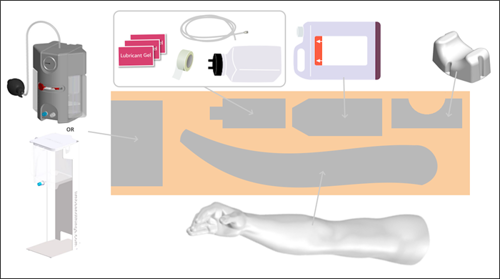
What's included with the venipuncture training arm?
| Product Components | Standard Venipuncture Arm | Advanced Venipuncture Arm |
| Core Venipuncture Arm Unit (ready to use): • Internal Arm Structure • Metacarpal Vein Module (fitted) • ACF Vein Module (fitted) • Arm Skin (fitted) |
Yes | Yes |
| Blood Supply Unit | Gravity System Blood Supply Unit | Pressurized Venipuncture Blood Supply Unit |
| Filling Bottle | Yes | Yes |
| Venipuncture Arm Infusion Tube | Yes | Yes |
| Venous Blood Starter Pack | Yes | Yes |
| IV Arm Support | Yes | Yes |
| Lubricant Gel Packet x 3 | Yes | Yes |
| Micropore Tape | Yes | Yes |
Your delivery will look similar to this:
Technical specifications
| Technical Specifications | Standard Venipuncture Arm | Advanced Venipuncture Arm |
| Dimensions | L 101cm x W 19cm x H 29cm | L 101cm x W 19cm x H 29cm |
| Weight (packed) | 5.4kg | 6.2kg |
| Materials - Arms | Silicone & polypropylene foam | Silicone & polypropylene foam |
| Materials - Veins | Contains Latex* | Contains Latex* |
| Recommended equipment (not supplied) | • 22 or 20 gauge cannulas (0.7-0.9mm needle width) • 21 gauge needles (0.8mm needle width)** |
• 22 or 20 gauge cannulas (0.7-0.9mm needle width) • 21 gauge needles (0.8mm needle width)** |
| Consumable components | • Arm skin (light or dark skin tone) • Metacarpal vein module • ACF vein module • Concentrated venous blood (refill) |
• Arm skin (light or dark skin tone) • Metacarpal vein module • ACF vein module • Concentrated venous blood (refill) |
*Latex veins allow for more needle insertions over time. We would always advise using gloves when using the IV arm and replacing parts. During procedures, the veins are covered by the silicone arm skin.
**Any size needle can be used with the IV arm, however, wider gauge needles can reduce the lifespan of the veins and arm skin and may void warranty.
How to set up the venipuncture training arm
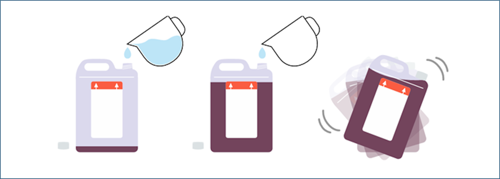
- Dilute the jug of Concentrate Venous Blood as stated on the label and shake well
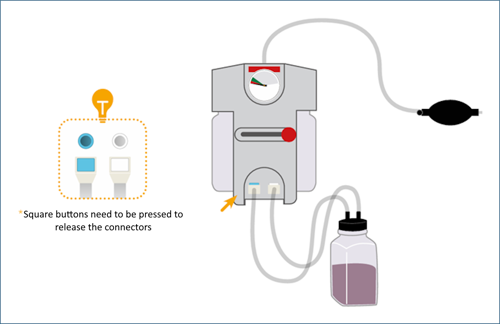
- Colour match the connectors from the refill bottle, to the front of the Advanced Pump. (If using the Standard Gravity Unit, colour match one connector to the front of the unit, and one to the top.)
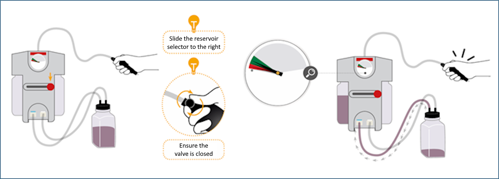
- Prime the system
- Slide the red selector to the right-hand side
- Close the valve on the black bulb
- Slowly pump the bulb until the left-hand reservoir fills to 300ml
- Open the valve on the bulb to release pressure
- Set out the Venipuncture Arm
- Place Arm Rest on a flat surface next to your primed pump unit
- Lay the arm unit, palm up, on the surface, with the upper arm in the divot of the Arm Rest
- Prime the veins
- Disconnect the refill bottle
- Colour match the arm connectors to the pump
- Slide the red selector to the left-hand side
- Ensure white clips on the tubing are open
- Slowly pump the black bulb until you see the liquid circulate the veins and begin filling the empty reservoir
- Continue to pump until there are no visible air bubbles in the tubing
- Close the white clip on the right-hand tubing to maintain pressure
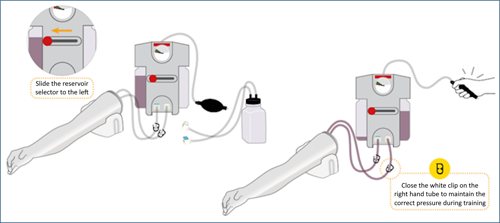
- The Venipuncture Arm is now ready to use
To watch the full length Hints & Things video, visit our YouTube Channel for the complete guide.
How to perform venipuncture on the training arm
Below is a basic venipuncture procedure to perform with the Limbs & Things Venipuncture Arms. More detailed procedures can be done, with the addition of a simulated patient to allow for addition core skills practise through professional to patient exchanges.
- Identify the veins – palpate the veins and identify where needle insertion will be made
- Apply a tourniquet – apply a tourniquet to the Venipuncture Arm
- Re-identify vein – re-check the vein for suitability
- Clean the site – clean the venipuncture site with an alcohol wipe in downward strokes
- Prepare the needle – prepare the needle as per instructions (dependant on needle type)
- Insert the needle – insert the needle into the vein, bevel upwards
- Confirm flashback – upon successful needle insertion, blood flashback will be seen in the vial
- Collect simulated blood – collect required blood, changing the vial if necessary
- Removing the tourniquet – while filling the final vial, loosen the tourniquet
- Remove vial – remove the filled vial from the needle holder
- Withdraw the needle – remove the needle and apply gauze over the puncture site
- Dispose of needle – carefully dispose of the needle in the appropriate sharps bin
Note: This is not an exhaustive procedure, and covers the steps directly connected to the arm and collection of blood from the arm.
Cleaning & Maintenance
After each training session, drain the simulated blood from the veins and pump.
Flush the system with water.
Between uses:
- Clean the arm skin as needed, using a soft damp cloth with warm water and mild detergent
- Rinse the blood system with a sterilising agent (suggested frequency, once a month)
Routine checks:
- Inspect skin, veins and tubing
- Check connectors
- Replace worn components (to learn how to replace the vein modules in a venipuncture arm trainer, watch our Hints & Things video on YouTube)
Top Tip: At the end of each training session, before draining the blood, wipe the surface clean and after a couple of minutes inactivity, check the skin surface for “blood beading”. If you notice blood reappear at common injection sites, this may be a sign that there is a leak beneath the skin, or the arm skin is reaching end of life.
Replaceable parts & accessories
The following items are consumables in venipuncture training arms and require replacement periodically (dependant on usage):
- Metacarpal vein modules, available in two pack sizes
- ACF vein modules, available in two pack sizes
- Arm Skin for Standard & Advanced Venipuncture Arms
- Concentrated Venous Blood
The following accessories are available to purchase:
- Gravity System Blood Supply tower and liquid reservoir (Standard Venipuncture Arm)
- Pressurized Venipuncture Mock Blood Supply (Advanced Venipuncture Arm)
- Venipuncture Arm Infusion Tube
- Venipuncture Arm Rest
- Refill Bottle
- Venipuncture Arm Carry Case
Benefits of simulation-based venipuncture training
Simulation-based venipuncture training allows learners to develop essential clinical skills in a safe, controlled, and repeatable environment. By practising on a realistic training arm before working with real patients, students can build both technical ability and confidence while reducing the risk of error in clinical settings.
Improved patient safety
Using a venipuncture training arm ensures that early-stage learning takes place without risk to patients. Trainees can make mistakes, refine their technique, and gain experience before performing procedures in real clinical environments. This is especially important for high-frequency procedures like blood draws and IV insertion, where precision and consistency are critical.
Hands-on skill development
Simulation provides practical, tactile experience that cannot be replicated through theory alone. Learners can practise:
- Vein palpation and identification
- Needle insertion technique
- Achieving blood flashback
- Securing IV cannulas
This hands-on repetition helps develop muscle memory and procedural accuracy.
Repetition without limitation
Unlike clinical placements, where opportunities may be limited, simulation allows for unlimited practice. Learners can repeat procedures multiple times across different sites, helping them improve consistency and refine their technique at their own pace.
Increased learner confidence
Practising on a realistic simulator helps reduce anxiety and build confidence. By the time learners perform venipuncture on real patients, they are more familiar with the process, equipment, and expected outcomes.
Standardised training & assessment
Simulation ensures that all learners are trained using consistent methods and scenarios. Educators can assess competency in a structured way, making it ideal for:
- Clinical skills assessments
- OSCE examinations
- Certification and competency checks
Realistic clinical preparation
Advanced training arms replicate key anatomical features and physiological responses, such as vein location and blood flashback. This helps bridge the gap between classroom learning and real-world practice, preparing learners for clinical environments.
Supports aseptic technique & best practice
Simulation training reinforces correct procedures, including:
- Infection control protocols
- Proper site preparation
- Safe sharps handling
By embedding best practices early, learners are more likely to carry them into clinical settings.
Simulation-based training is now a core component of modern healthcare education, helping institutions deliver safe, effective, and scalable clinical skills training while improving outcomes for both learners and patients.
Frequently Asked Questions
What is a venipuncture training arm used for?
The Venipuncture Arm range supports both venipuncture (obtaining blood samples, monitoring levels in the blood and intravenous injections) and IV cannulation (administering fluids for hydration, blood or blood components, and drugs).
Peripheral skills can also be taught using the arm models, such as:
- Preparation of injection site
- Securing catheters
- Professional to patient communication
- Usage of blood collection apparatus (inc. Vacuette® system tubes, and tourniquets)
- Safe removal of needles
- Cleaning techniques for injection sites
- Safe disposal of needles and medical waste
Can you practice IV cannulation on this simulator?
Yes, intravenous cannulation can be performed on the venipuncture arm range.
How realistic are the veins in the training arm?
The true-to-life design gives the most accurate key haptics of veins under the skin
How many punctures can the skin withstand?
Arm Skin in the Venipuncture range can support around 500 punctures before replacement is necessary.
Note: Usage will depend on accuracy of needle insertion and use of alternative needles to those recommended.
How many punctures can the veins withstand?
Modular vein components can support around 500 punctures before replacement is necessary.
Note: Usage will depend on accuracy of needle insertion and use of alternative needles to those recommended.
Does the simulator provide blood flashback?
Yes, users will see blood flashback upon successful needle insertion.
How do you clean a venipuncture training arm?
After every use:
- Drain the remaining blood from the vein and pump system
- Fill and flush the system with clean water
- Wipe the arm skin with a soft damp cloth, using warm water and mild detergent (also check underneath the skin for leakage and clean if required)
- Allow components to dry thoroughly before storing
- We recommend adding a sterilisation agent (such as Milton) to the water, periodically, when flushing the system
Can we upgrade our existing Standard Venipuncture Arm to the Advanced?
Yes, you can purchase the pressurised blood system to convert the Standard IV arm to the Advanced. The pressurised systems gives consistent and realistic blood pressure, for true to life training.
How often does the synthetic blood need to be replaced?
We recommend changing the diluted liquid at least once every 12 months. The formula includes an EU approved preservative that extends the life of the solution, making it safer to use over extended periods, as well as being safer on skin contact and less hazardous when disposed of.
For best shelf life, ensure the jug is sealed tightly and stored in a cool, dark, place between uses. Monitor the liquid for signs of crystallisation or separation, if you observe any changes, we would recommend replacing the solution.
What equipment can be used with the venipuncture simulator range?
Any existing equipment can be used with the Venipuncture Arms, however, for best usage, we recommend the following:
- 22 gauge or 20 gauge cannulas (0.7mm to 0.9mm needle width)
- 21 gauge needles (0.8mm needle width)
Wider gauge needles can be used, though this will reduce the life span of the veins and arm skins, and potentially void the warranty of the product.
Why choose Limbs & Things venipuncture trainers?
Limbs & Things venipuncture trainers are designed to support high-quality clinical skills education, combining anatomical realism with durability and ease of use. Developed in collaboration with healthcare professionals and educators, these simulators are trusted by training institutions worldwide to deliver effective, hands-on learning experiences.
Realistic anatomy & tactile feedback
Each trainer is engineered to replicate the look and feel of real human tissue and veins. Learners can practise vein palpation, needle insertion, and blood draw techniques with realistic resistance and feedback, helping bridge the gap between simulation and clinical practice.
Designed for repeated practice
Built for busy training environments, Limbs & Things Venipuncture Arms are made from robust, high-quality materials that withstand repeated use. Replaceable skins and vein systems extend product lifespan, making them ideal for:
- Skills labs
- Classroom teaching
- High-volume training sessions
Supports a range of clinical procedures
These trainers are suitable for teaching multiple vascular access techniques, including:
- Venipuncture (blood collection)
- Peripheral IV cannulation
- Intravenous infusion setup
This versatility allows educators to use a single simulator across different training modules.
Trusted by educators worldwide
Limbs & Things products are used across universities, hospitals, and clinical training centres globally. Their focus on educational outcomes and user feedback ensures that each product meets the needs of both instructors and learners.
Easy to set up & maintain
The venipuncture trainers are designed for straightforward setup and maintenance, allowing educators to spend more time teaching and less time managing equipment. Components such as skin and veins can be quickly replaced, helping minimise downtime between sessions.
Enhances confidence & competency
By providing a safe and realistic environment for practice, Limbs & Things trainers help learners build confidence, competence, and consistency before progressing to real patient care.
Choosing Limbs & Things means investing in a training solution that supports effective skill development, long-term usability, and high-quality clinical education outcomes.
The complete Venipuncture Arm Range
| Quantity/Packs | Standard | Advanced |
| Single Light Skin Tone Arm (1 unit) | 70302 | 70300 |
| Single Dark Skin Tone Arm (1 unit) | 70303 | 70301 |
| Value Pack Light Skin Tone (5 units) | 70322 | 70313 |
| Value Pack Dark Skin Tone (5 units) | 70323 | 70314 |
| Value Pack Mixed Skin Tone (2 light units + 2 dark units) | 70324 | 70318 |


Thanks for reading!
Found this article useful? Why not share it with a colleague, or contact us about another product you'd like to hear more about.
