
Validated Trainer to Support NHS ‘Avoiding Brain Injury in Childbirth’ Initiative
Following a successful pilot, the UK Government has launched the Avoiding Brain Injury in Childbirth (ABC) programme with over 90 NHS trusts using Limbs & Things' evidence-backed simulation model, PROMPT Flex, to execute new training requirements.

The UK Government’s ABC programme tackles brain injury in childbirth by establishing rigorously tested procedures targeting the common causes. This includes the appropriate management of impacted fetal head (IFH) during caesarean which is being tackled with training using our PROMPT Flex Birthing Simulator and Enhanced C-Section Module in over 90 of the UK's NHS trusts.
Brain injury sustained during birth has devastating consequences for both babies and families and produces significant cost to healthcare services in terms of care and litigation. With up to 10% of caesarean births in the UK complicated by IFH and a dramatic rise in reported perinatal brain injuries linked to the complication [1], a new initiative to address the issue is imperative.
Developed over 4 years by multidisciplinary experts across the Royal College of Obstetricians and Gynaecologists (RCOG), Royal College of Midwives (RCM), and The Healthcare Improvement Studies (THIS) Institute, the ABC programme provides a standardized training system to boost effective response to obstetric emergencies.
Published research recognizes current inadequacies with ‘relatively few obstetricians [receiving] practical training… in disimpaction techniques’ and a prevalent lack of confidence in executing disimpaction procedures [2,3]. To counter this, the validated [4] Limbs & Things PROMPT Flex Birthing Simulator with Augmented Reality (AR) and Enhanced C-Section Module (ECSM) were employed as part of the ABC pilot training programme to examine whether simulation-based training could alleviate concerns.
The pilot revealed that ‘multi-professional [simulation] with a validated, high-fidelity birth simulator’ can lead to ‘improved knowledge, skills and confidence’ in management of IFH [1,2]. Using simulation as a tool for training gives professionals a clear understanding of the complexity of IFH and provides multidisciplinary teams a platform to rehearse communication and coordination of roles.
The new ABC Programme rolled out across the NHS applies these findings to produce a structured training scheme which includes crucial sessions with validated simulation. The Government are confident that the programme will improve outcomes by helping professionals to respond more effectively to obstetric emergencies [5].
Our validated [4] PROMPT Flex Birthing Simulator and the ECSM are being used by over 90 NHS trusts across the country to support the new programme, with research verifying the prototype of the now released model provides a realistic representation of IFH and allows for rehearsal of all disimpaction techniques.
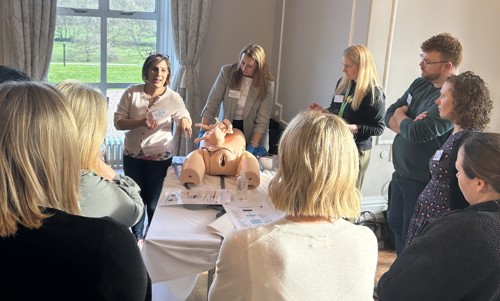 The PROMPT Flex Birthing Simulator and Enhanced C-Section Module being used during the ABC programme launch in the Southwest.
The PROMPT Flex Birthing Simulator has had a long-standing history of clinical backing. Developed in collaboration with the PROMPT Maternity Foundation, the model has been used in several studies to validate the use of simulation to improve neonatal outcomes [6, 7, 8].
The latest version of the model includes AR which allows learners to visualise how the mother and baby’s anatomy behave during different birthing scenarios, breaking down concepts that are difficult to teach into visuals that are easy for students to grasp.
Discover more about the PROMPT Flex Birthing Simulator with AR, the ECSM, or learn more about our AR app which you can download and explore for free, by clicking the links below.
PROMPT Flex Birthing Simulator with AR | Enhanced Cesarean Module | AR app
[1] Training for managing impacted fetal head at caesarean birth: multimethod evaluation of a pilot
[2] Management of Impacted Fetal Head at Caesarean Birth (2025 Second Edition)
[3] Impacted fetal head at caesarean section: a national survey of practice and training
[5] New NHS programme to reduce brain injury in childbirth
[6] Improving Neonatal Outcome Through Practical Shoulder Dystocia Training
[7] Management of shoulder dystocia: skill retention 6 and 12 months after training
[8] Shoulder dystocia training using a new birth training mannequin
Did you like this article?
Share it on social media, and remember to tag us!
