
Augmented reality: the answer to free and accessible medical teaching?

This year, UNESCO’s International Day for Digital Learning highlights the transformative potential of educational digital spaces. Utilising breakthrough tools to enhance learning experiences is a fundamental driving force towards making learning quicker to grasp, easier to teach and more accessible.
Augmented reality is a technology that, throughout its development, has been integrated into learning systems across the world. While often misconstrued as ‘too technical’ for the average person, AR is well integrated into daily life. Social media filters, live map directions and virtual overlays on live sports games, are all examples of AR that we experience day-to-day.
AR refers to any system that overlays digital information onto the real-world in real-time. This idea has long been used for educational purposes, with the first AR system being developed by the US Air Force for training among other purposes.
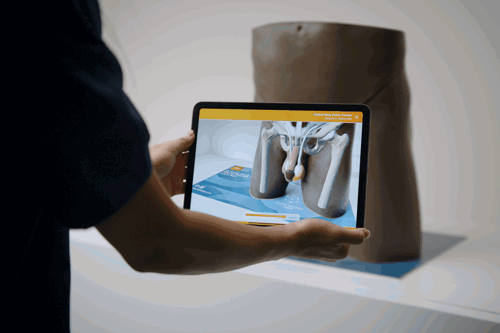
Augmented reality view of internal structures in the male pelvis by Limbs & Things.
In medical education, AR presents a unique way for students to gain a level of anatomical understanding that would otherwise be much harder to achieve. When presented with a patient requiring tactile examination or a procedure, a sharp recollection of underlying structures is essential.
Viewing anatomy diagrams overlayed onto a physical anatomical model aids comprehension of structures while learners still have a basis to practice physical skills. The combination of the two learning mediums has the potential to boost understanding of medical concepts beyond what is possible with just one.
Building on this idea, Limbs & Things have incorporated AR into many of their medical simulation trainers. Free and accessible on the Limbs & Things AR app, learners can interact with 3D anatomy overlaid onto compatible models and even revisit these models in study sessions outside of the classroom.
Limbs & Things’ AR creates an educational digital space that goes hand in hand with traditional methods of study using physical task trainers, providing a novel way to bridge the gap between theory and practice. Being able to view animations of procedures while practicing them simultaneously on the model revolutionises the game for medical learning materials. Accessible to all with free download and no ongoing costs, this breakthrough tool will only strengthen as Limbs & Things expand their AR compatible models.
Did you like this article?
Don't forget to share and tag us!
